Payment protection
The money waits until your customer says the work is done.
Your customer pays at the end of the job, the way they always have. What changes is what happens next. The payment is held under a full refund guarantee, and it stays there until they confirm the work held up.
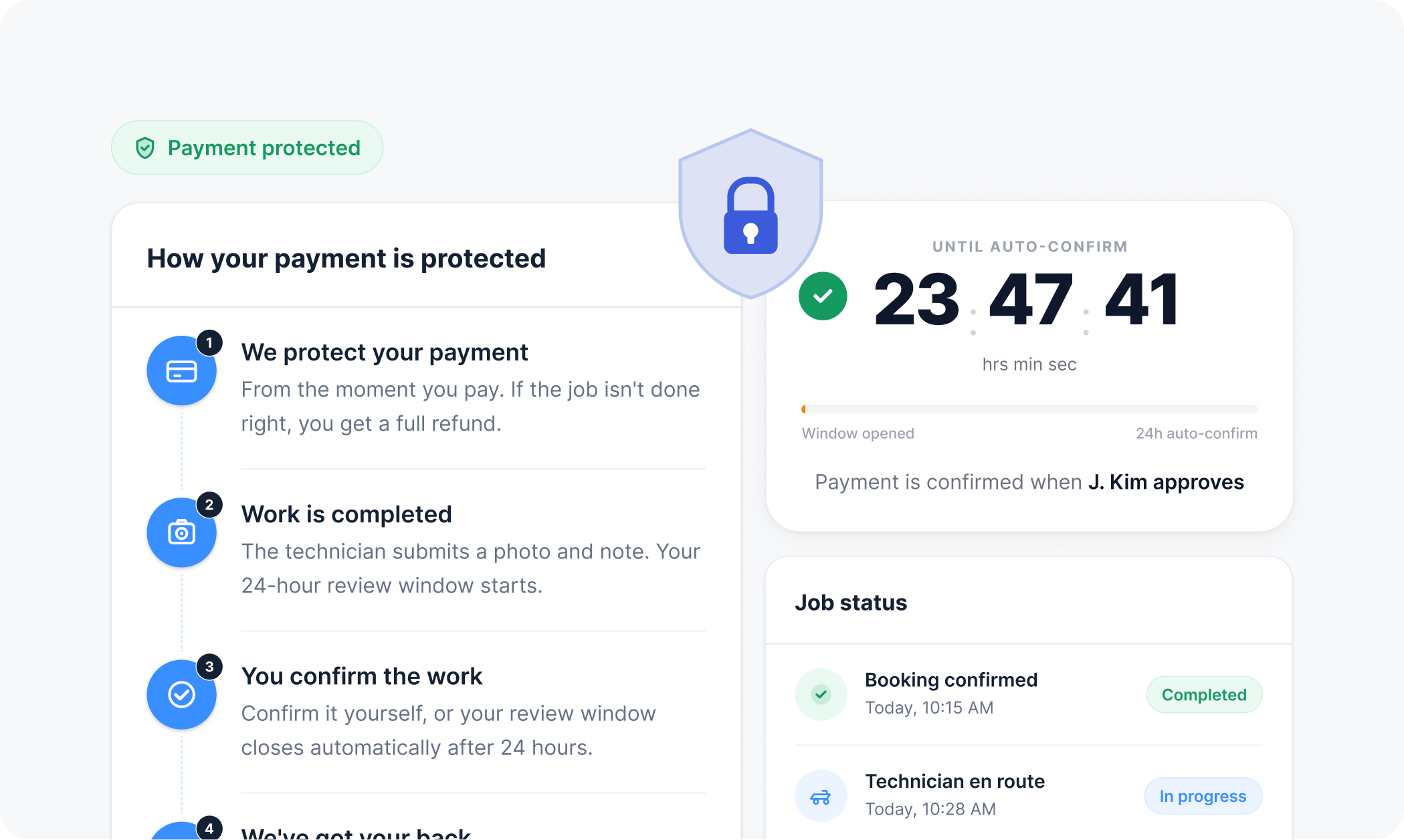
Protection is a promise about the money, not a promise about the invoice.
Nothing about the way you collect changes. Your tech closes out the job and takes payment exactly as they do today. The difference is that the payment is not final yet. It is held, and it carries a full refund guarantee your customer can act on until they tell you the work is done.
That one delay is the whole product. It moves the question of whether the job was actually done from six weeks later, in front of a card issuer, to the same afternoon, in front of you.

Every job sits in one of three states.
Your customer can see which one at any point, and so can you. Nothing about a job is ambiguous while the money is in motion.
Held
The customer has paid. The money is protected and neither side can move it. Your customer can see that it has not reached you yet, which is exactly why they were willing to pay on the spot.
Released
The customer confirmed the work is done. Payment released, and the job closes with their answer attached to it.
Returned
The customer flagged a problem. The money goes back to the card they paid with, and the conversation stays between the two of you.
There is no fourth state where your customer calls their bank to find out what happened to their money.
Four things the protection layer can do.
Confirm
Your customer answers one question at the end of the job: is this done? That answer is the trigger for everything else.
Release
A yes releases the payment. No invoice to chase, no waiting period, no second approval sitting in somebody's inbox.
Pause
A problem holds the money exactly where it is. You get the chance to send someone back before anyone thinks to involve a bank.
Split
When a sub did the work, both sides are released on the same confirmation, so the sub is paid on the same fact you are.
What your customer sees.
Before the job, a guarantee written in plain language they can read on the estimate. During the job, nothing to install and nothing to sign up for. After the job, one question in an email and an answer that takes a single tap.
Customers who are handed a real way to say something is wrong tend to use it instead of calling their card issuer. That is the entire point.
Where the money sits while it waits.
Funds under protection are held at JPMorgan Chase. Every confirmation is timestamped and filed against the job, so the record of what your customer agreed to exists before anyone needs it.
See the security detail →