Dispute prevention
A chargeback is a conversation you were not invited to.
By the time a bank tells you a customer disputed a charge, the customer has already decided, already explained their side, and already been believed. TrustLayer moves that conversation to before the money moves, while you can still fix the thing they are unhappy about.
The timing is the whole problem.
When payment clears the moment a tech marks a job complete, the only thing that has happened is that your company made a claim. The customer never agreed to it. Nobody asked them.
Weeks later, when the drain backs up again or the seal fails or the room still smells the way it did before, the customer has one place left to take that. They take it to the company that holds their card. That company has never met you, will never send anyone to look at the work, and decides on paper.
Confirmation closes the question while it is still cheap to answer.
TrustLayer asks your customer one question at the end of the job: is this done? Their answer is timestamped and filed against the job. A customer who confirmed the work is a customer who agreed, in writing, before a dollar moved.
Without confirmation
Completion is your word against theirs. The record you bring to a dispute is a record you wrote yourself, which is why it usually loses.
With confirmation
Completion is something the customer put their name to. The record is the customer's own answer, given at the time, on the job it belongs to.
The complaint comes to you, not to the bank.
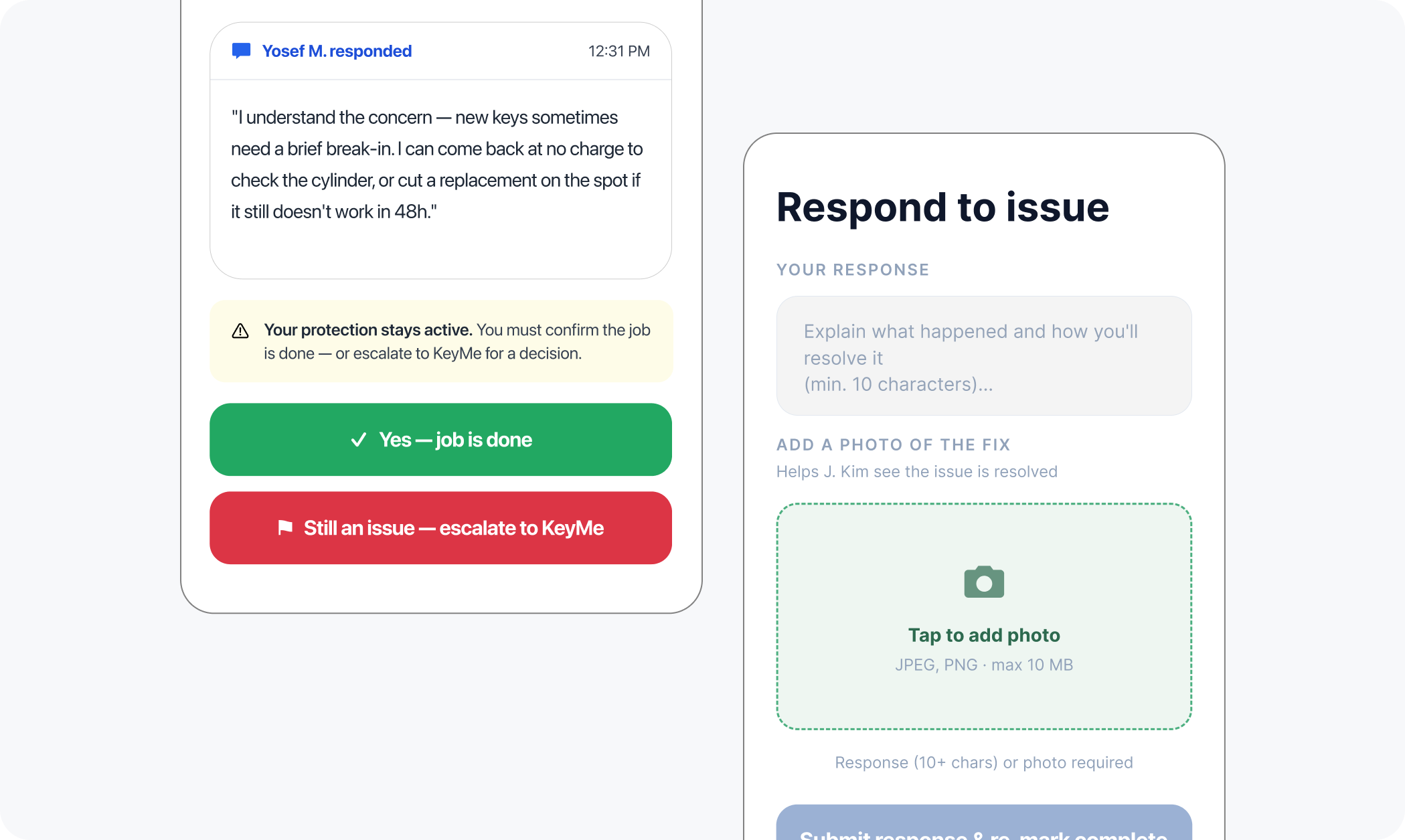
An unhappy customer will do something. The only question is where. Give them a button that pauses their own money and holds it until somebody looks at the work, and most of them will press that instead of dialing the number on the back of their card.
A paused job is a callback. A chargeback is a callback that nobody made in time. The work involved is often identical. What differs is whether you still have the money, the customer, and the review.
What a dispute actually costs you.
The invoice is the smallest line on the bill. There is the technician hour already spent, the parts already installed, the fee the card network charges for the privilege of being disputed, and the hours somebody in your office spends assembling a case that will be decided by a stranger reading a form.
Then there is the part nobody puts in a spreadsheet. A customer who disputes a charge is a customer who is finished with you, and who is about to tell the neighborhood why.

If it still goes to a dispute, you are not starting from nothing.
Every job files a record: what was agreed, what the technician reported, what the customer answered, and when each of those happened. It is built while the job is running rather than assembled afterward, which is the difference between evidence and a story.
See what the record holds →