For subcontractor work
Once the sub is paid, the callback is yours.
The sub finishes, you pay, the sub moves on. Then the property owner calls, and the only person left to fix it is you. TrustLayer holds sub payment until the customer signs off, so the redo happens while coming back is still in the sub's interest.
The leverage problem
You pay twice, and only one of those is in the budget.
Sub payment tied to the sub's own completion is payment tied to the sub's own opinion. Once the money is out, your leverage is out with it. The callback becomes your labor, your truck, your margin.
Holding sub payment until the customer confirms does not change your relationship with the sub. It changes when the money moves by a few hours, and it changes who fixes the problem.
How it works here
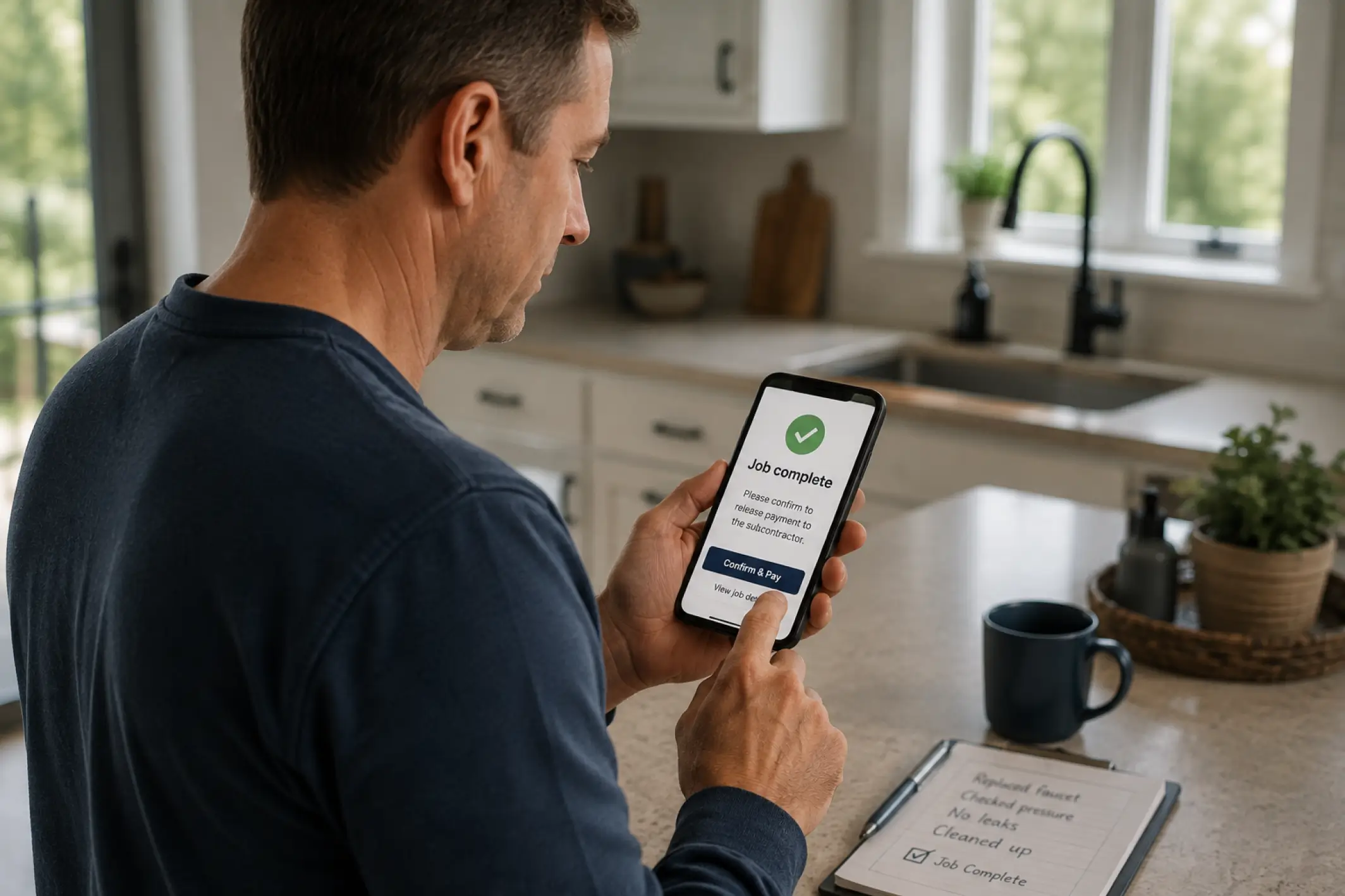
The customer's confirmation releases the sub payment.
The sub marks the job complete with a note and a photo. The payment stays protected. The property owner is asked to confirm. Their confirmation releases the money to the sub and files the approval record.
If the owner flags an issue, the payment pauses and you know before the sub is gone.

Split resolution
The rare bad job does not have to be all-or-nothing.
Sometimes the sub did most of it right and the last part wrong. Refunding everything punishes work that was fine. Refusing to refund punishes a customer with a real complaint.
You enter two independent amounts: what the sub gets paid, what the customer gets refunded. Settle it proportionally. The loss, if there is one, is tracked.
.webp)
Callbacks
The callback you prevent is the cheapest one.
A flagged job is a redo scheduled while the crew is still on the street and the money is still a reason to go. A callback discovered three weeks later is a second truck roll out of your margin.
In restoration and roofing, where one ticket can carry a week of revenue, the difference between those two is the whole job's profit.
.webp)